
Within VFX Houdini is often regarded as one of the harder softwares to get started within. Because of the way it is both node based and point based, it has a slightly different workflow to that of other 3D softwares. Therefore it is true that at the beginning there is absolutely a steeper learning curve, as it take adjustment to understand the Houdini workflow. However, these difficulties are exactly where it’s greatest strengths lie.
What exactly does a point based software mean? Technically speaking any 3D software relies on the manipulation of points. But with Houdini, everything can be stripped back down to what is ‘this individual point do’ and how can a user adjust this point with custom made parameters (attributes). Because so much information is stored in points it’s a software that is very well adjusted to make small scale/large scale simulations.
So what kind of simulations are able to made within Houdini? It really isn’t limited to the software but rather the users knowledge of the software. This being said some of the more common simulations can include water (FLIP), pyro, particles (POPS), growths, destruction (RBD) and many more. Within almost all of these simulations, the starting point begins with particles. In fact, because POPS is so much faster, and requires less data, often the workflow will be to create something within POPS and then feed it into a pyro solver. This would be a great example of a workflow for smoke trails for example.
Let’s just into an example and demonstrate the benefits of procedural modelling. Here we have a rock generator. Which almost every Houdini has built many times. This is a great exercise for beginner Houdini artists as it will introduce you to the absolute basic global attributes, such as normals and pscale.

So in this generator, there are a few controls in order to control the general scale of the rock, controls for the veins and the noise, and also whether to make it into a meteorite or not. What is interesting about this setup is that is also begins with the scattering of some points.
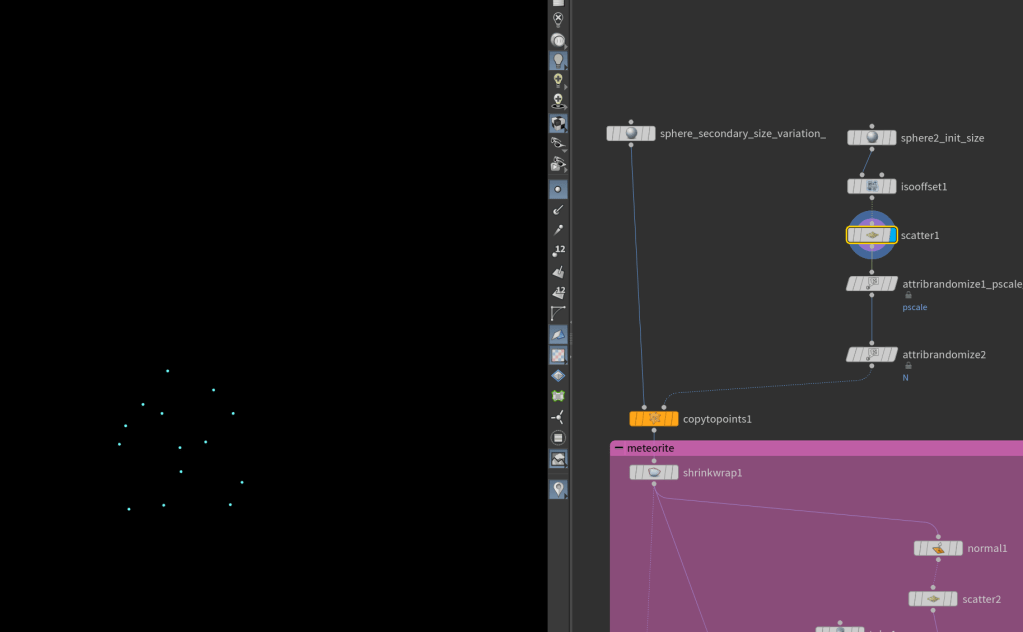
From these points we can then copy to points some spheres and that is ultimately the beginning of our setup. This may seem quite specialised for this type of tool. However, with using Houdini it is often found that a very similar setup is used. But it will of course be adjusted to create the base source of whatever is needed for that particular simulation.
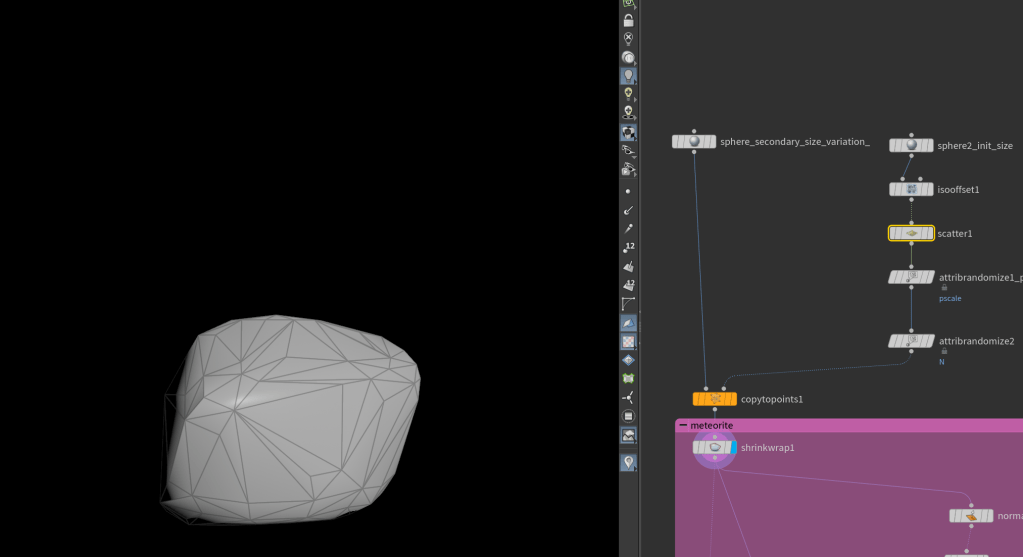
The possibilities of Houdini are truly endless. From procedural modelling, to growth and decay. There is so much that can be done. What is important to note is once you have the fundamentals down, everything else becomes much more accessible.
 THE ART OF VISUAL EFFECTS AT ESCAPE STUDIOS